


I’ve just returned from seven slow, carefree days in Tasmania, the kind of trip where time loosens its grip on you. There were no tight schedules, no shopping lists, no urgency to “see it all.” Just open roads, cold air, long walks, and landscapes that asked nothing of us except attention.
Tasmania is generous in that way. It offers wilderness without spectacle: World Heritage landscapes, rugged mountains, ancient forests, pristine beaches and alpine lakes. Beauty that doesn’t announce itself. Beauty that waits.
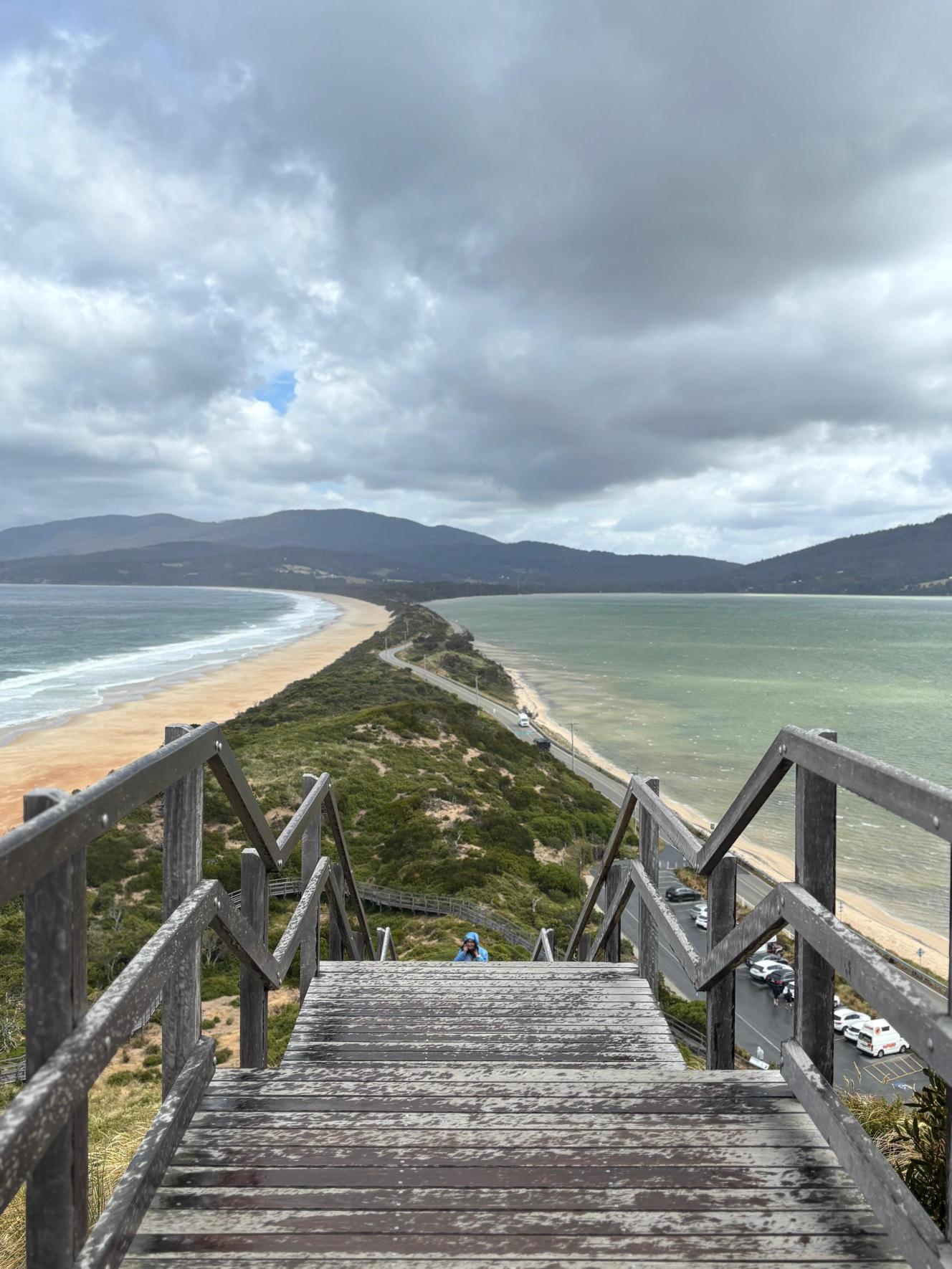
Almost every day, we crossed paths with other travellers, some of them standing before these vast natural scenes with a look that felt… uncertain. Not disappointed exactly, but perhaps underwhelmed. I noticed the pauses were brief. Photos were taken quickly. Conversations drifted toward what was next, what else there was to see, how long this stop needed to be. One family, annoyed with a lookout, even announced it to us as we hiked up. There is nothing much to see, just views, and its very windy.
Somewhere between that quiet lookout and another winding trail, the contrast became clear. For us, the absence of activity, the unpredictability of nature and being attuned to it was the experience. We lingered. We stayed longer than necessary because there was no necessity at all. The reward came slowly, in the way the light shifted, in the calm that arrived when nothing demanded our response.
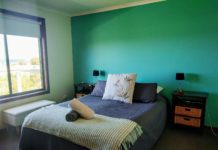
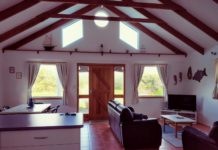
Even our accomodations reflected this intention. Each was chosen with care: one looking out at Mount Wellington, another in Launceston with sweeping views and a third tucked deep in the woods, where rabbits and farm animals moved quietly through the day. We watched Mount Wellington change character with the hours. In Launceston, a wide yard stretched out below us, where a couple of horses grazed and a caravan sat still. I was content simply to observe.
For many travellers shaped by fast-moving, goal-oriented lives, nature seemed to pose an uncomfortable question: What do you do here? There was no shopping, no marquee attraction, no immediate payoff. Tasmania didn’t perform. It didn’t market itself. It refused to compress its value into a single frame. As Rebecca Solnit writes, leave the road, take the trails — a quiet invitation Tasmania extends at every turn.
That contrast clarified something about me.
I don’t travel to be stimulated; I travel to be softened. Cities sharpen me. Nature dissolves the edges. In places like Tasmania, I’m reminded that I don’t need to be constantly engaged to be fully alive. That stillness isn’t emptiness, it’s depth.
This isn’t a judgment of how others travel, only an observation of orientation. Some people travel to add — experiences, possessions, stories. I travel to subtract. To loosen my grip on noise, expectation, and the hunger for novelty.
Tasmania rewards that way of moving through the world. It asks for patience, presence, and a willingness to sit with boredom before being moved. In return, it offers something increasingly rare: the sensation that time is no longer pursuing you.
After seven days, I returned with no purchases, no dramatic photographs, no list checked off. What came home with me was subtler and more enduring, a loosening. Of urgency. Of expectation. Of the need to be entertained.
Some places ask you to move faster, to look harder, to take more. Tasmania asks the opposite. It asks you to slow down long enough to notice what remains when nothing is demanded of you.
Not every journey announces its value. Some work quietly, reshaping the way you sit with time, the way you listen, the way you breathe. You don’t always recognise the change as it happens. You feel it later, in the gentler pace you keep, in the spaces you no longer rush to fill.
Perhaps that is why some people leave places like Tasmania asking whether it was worth the journey.
Others leave knowing it was, not because something extraordinary ocurred, but because, for a moment, nothing needed to.








Love it, Linu! For me, the beauty of nature is the attraction
Thanks so much Chris. Same for me as well 🙂